Showing posts with label manipulatives. Show all posts

Tuesday, September 17, 2013

Interactive Math Notebook: Factors and Multiples

Welcome to our Math Corner! Please come back often and leave a comment below to let me know your thoughts or any other ideas you have to add!  Also, I would love a follow! :) Thanks!

We have been busy working on determining whether one number is a factor or multiple of another number.  We started by building arrays both with tiles and on centimeter grid paper to determine a number's factors.  Becoming proficient at building arrays has really helped some of my struggling students feel successful in finding factors even when they aren't proficient in their facts or have many strong strategies to use to determine a fact.  After practicing many many times,  I gave each student a pair of die (some were six sided, some were more for my kids who are proficient in their facts and wanted a challenge!) and grid paper and instructed them to roll the die and create an array with dimensions that match the numbers on the die.  We then added this page to our notebooks.  Below is an example.  


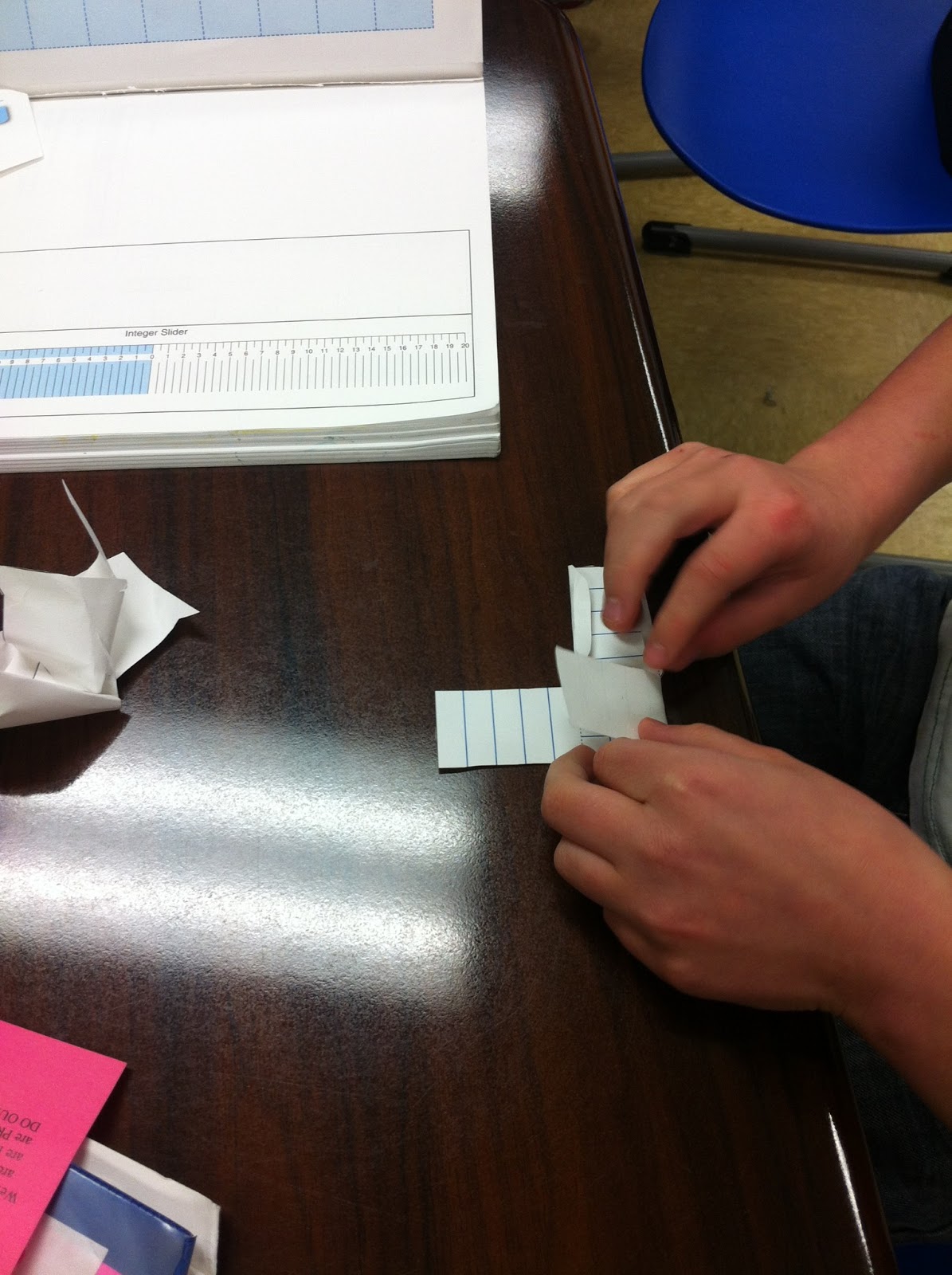
Next, we used our Math Handbooks and its Table of Contents (oh hello, Language Arts skills! See....I'm learning how to incorporate it all!) to find the definition and examples of factor, prime number, composite number, and square number.  We used this information to create a foldable to glue into the right hand side of the page.  An example is below!


We are also learning about multiples.  After many days of discovering, discussing, and applying this knew knowledge, we finally were able to put the information into our notebooks.  I always try to wait until I feel they understand it to put it into the notebooks.  We used a hundreds chart to choose a factor, then highlighted all of its multiples.  We also used this factor to create a basic real world problem to show how to apply it to multiples.  
This student chose the factor two, and wrote the problem: A store has CDs for $2 each.  She then drew a picture to show that one CD would cost $2, two CDs would cost $4, three would cost $6, and so on.  This shows that the price of buying CDs are multiples of 2

This student chose the factor four.  His problem is about video games costing $4 each, so two would cost $8, three would be $12, and so on.  He goes on to begin to write a question associated with it!

Lastly, I really wanted to make sure we understood the difference between factors and multiples, as it can get very confusing.  We used markers to circle all the factors in a list and all the multiples associated with it.  Students were allowed to pick their own factor, or for those who are still not feeling comfortable with multiplication, were permitted to use the factor four as I did in my example.  Then, they showed an example of an array that shows one of their listed factors and multiples, as well as a non array (just to make sure they understood that an array is a rectangle and cannot have any pieces sticking off the end!!).  These last two pages might be my favorite!  


This student wrote all the problems for the number four.  He circled all of the fours to show that is the factor.  He wrote: 4 is a factor of any whole number that it divides evenly.  He also circled all the multiples to show that you can multiply any number by four to get a multiple of four.

This student did an excellent job of showing the difference between an array that four is a factor of one of its multiples, as well as a non example saying "21 is not a multiple of 4" and using his array as proof!


Tuesday, September 10, 2013

Arrays: The Gateway to Multiplication

Our first unit is all about factors, multiples, and arrays.  I know from teaching 5th grade that if students don't understand what multiplication truly shows, they are missing the foundation to a deeper understanding of numbers, as well as the key to success with many many other parts of math.  That is why I plan on really spending time this year developing a deep understanding of multiplication, how numbers are related, and strategies students can use to help them if they get stuck.

We first began, as always, using manipulatives.  We have these wonderful one inch tiles that are perfect for creating arrays, but connecting cubes work as well.  We discussed what the word "dimensions" mean when looking at the lengths of each side.  We started by practicing arrays with smaller numbers and built our way up.  Once I felt they understood, I put them in pairs and gave them each two numbers to find all the arrays for.  An example of our work is shown below! (Please ignore the fact that the array she has showing shows 4x5 and is not an array for 18!  She was actually building for their next number: 39)


This activity led into a discussion about why certain numbers had only one array, like 17.  It was a "prime" time to talk about prime numbers!  We displayed the posters throughout the room and refer to them often, especially when discussing multiples, factors, and special numbers!


If you have any suggestions for other awesome activities, or ways I can improve, please leave a comment below!  Thank you!

Wednesday, April 3, 2013

An Exploration of Volume

Ok ok....So it's April and I taught volume almost a month ago.  Things can get pretty hectic this time of year, what with preparing for the OAA and making sure my kids are in tip top shape to show what they know!  Now that we're on Spring Break, I can finally sit back and reflect on what we've been learning and where we need to go after this.

I truly feel that math should be a hands-on experience for kids of all ages.  It shouldn't stop in 3rd grade.  All too often, we get caught up in making sure they know how to do it on paper and apply formulas, but kids need to be able to touch and feel what they are learning to really grasp it and understand it.  I always try to give them thorough hands-on experiences before teaching them the "math" part: formulas and equations.  So far, I think we've been pretty successful.  But, as in most cases, time is always an issue.  We just have to keep moving, moving, moving!

As will area and perimeter, we did an exploration of volume.  Many of my students had remembered the formula for finding the volume of a rectangular prism from 4th grade, but I wasn't really sure they understood or remembered WHY you multiplied LxWxH.  Thanks to Everyday Math, each student had the net of two different open rectangular prisms in the back of their math journals.  We made predictions for how many cubes we thought would fit into each.  These predictions actually gave me pretty good insight as to where each student was in their understanding of volume.  Then, of course, we began filling!


 We started by just filling the base of the prism and finding out many cubes that was.  I wanted them to see this as the area of the base: of course, some did, some didn't.  We will keep working on this idea of area! (Too often, their idea of area is just a rectangle on a page....must change that thinking!!).  Then we added another layer, and finally a third.  This allowed them to see that we were adding the area of the base however many times tall it was.  For the second prism, we only filled the base and predicted what the volume would be based on the results of the first prism.  From this, we developed the formula for finding the volume of a rectangular prism!

As an extension, and because we had a couple extra minutes at the end of class, I had each student build a rectangular prism on their desk with a volume of 24 cubic centimeters.  I didn't give them any more specifications than that.  After a minute or two of building, I began recording different lengths, widths, and heights that I saw around the room.  Once they saw all the possibilities, hands flew in the air.  They remembered what we had learned about multiplication being part of the commutative property and knew they could use the factors of 24 to build many many different prisms, all with the same volume.  Ah ha moments are the best :)

Lastly, here is the anchor chart we came up with.  They wanted me to point out that volume is "all about the threes":

Volume!